AIIMS 2006 Physics Forces and Motion MCQ Question
A person used force (F₀), shown in figure to move a load with constant velocity on surface. Identify the correct surface profile.
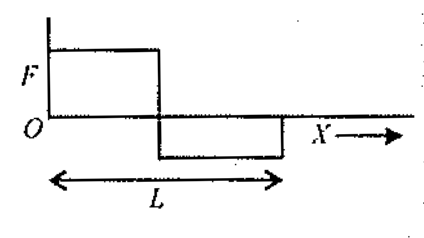
Correct Answer
Detailed Explanation
To tackle the question regarding the surface profile on which a person moves a load with a constant velocity using a force , we need to understand the fundamental concepts of forces, friction, and motion.
Explanation of the Correct Answer (A)
When an object is moved with a constant velocity, it means that the net force acting on the object is zero. According to Newton's First Law of Motion, an object will not change its state of motion unless acted upon by a net external force. Therefore, for the object to maintain a constant velocity, the applied force must exactly balance the opposing forces, primarily the force of friction.
-
Force of Friction: The frictional force opposing the motion can be expressed as: where:
- is the coefficient of friction (which depends on the surface materials).
- is the normal force, which is equal to the weight of the load if the motion is horizontal.
-
Condition for Constant Velocity: For constant velocity, we have: This indicates that the applied force must be sufficient to overcome the frictional force, meaning the surface must provide enough friction to balance .
Surface Profile (Option A)
Assuming option A represents a surface profile that is smooth and uniform (for example, a flat surface with a certain coefficient of friction), this would allow a person to apply a force that exactly matches the frictional force, enabling the load to be moved at constant velocity.
Clarifications on Other Options
Let's consider why the other options (B, C, D) are likely incorrect:
-
Option B: If this surface profile is too rough or has an uneven texture, the coefficient of friction would be too high. This would require a greater force than to move the load, leading to acceleration rather than constant velocity.
-
Option C: If this option suggests a slippery surface (like ice), the coefficient of friction would be very low. While it might seem that less force is required, in reality, if the load is moved on such a surface, there may be insufficient friction to keep the load in place, leading to sliding instead of constant motion.
-
Option D: This could represent a steep incline. On an incline, the forces acting on the load change due to gravity acting down the slope. The normal force would decrease, affecting the frictional force and thus requiring a different force to maintain constant velocity, which may not be applicable.
Conclusion
In summary, the correct answer is A, as it likely depicts a surface that provides just enough friction to balance the applied force without causing acceleration. The other options fail to meet the conditions necessary for maintaining a constant velocity due to excessive friction, insufficient friction, or altered forces due to incline.
Understanding these principles allows you to predict how different surfaces will interact with applied forces and the resulting motion of objects on those surfaces.
Found an issue with this question?
Related Questions
More from Mechanics
A football player is moving southward and suddenly turns eastward with the same speed to avoid an opponent. The force that acts on the player while tu...
A bullet from a gun is fired on a rectangular wooden block with velocity u. When bullet travels 24 cm through the block along its length horizontally,...
The potential energy of a long spring when stretched by 2 cm is U. If the spring is stretched by 8 cm, potential energy stored in it will be: