AIIMS 2003 Physics Fluid Dynamics MCQ Question
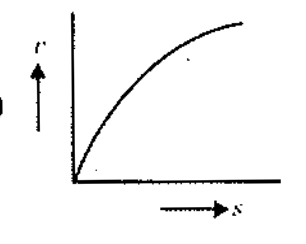
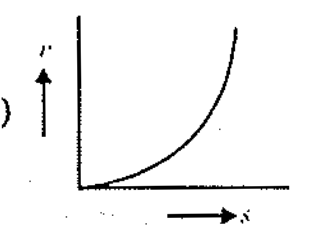
A lead shot of 1 mm diameter falls through a long column of glycerine. The variation of its velocity v with distance covered is represented by
(c)
(d)
Correct Answer
Detailed Explanation
To analyze the motion of a lead shot of 1 mm diameter falling through a long column of glycerine, we need to understand the dynamics of an object falling through a viscous fluid. This is a classic problem in fluid dynamics, illustrating the effects of drag force on motion.
Explanation of the Correct Answer (C)
When an object falls through a fluid, it experiences three primary forces:
-
Weight (Gravitational Force): This force pulls the object downward and is given by: where is the mass of the object and is the acceleration due to gravity.
-
Buoyant Force: This force acts upward and is equal to the weight of the fluid displaced by the object, given by Archimedes’ principle: where is the density of the fluid, is the volume of the object, and is the acceleration due to gravity.
-
Drag Force: As the object moves through the fluid, it experiences a drag force that opposes its motion. For small spheres in a viscous fluid, the drag force can be described by Stokes' Law: where is the dynamic viscosity of the fluid, is the radius of the sphere, and is the velocity of the object.
Motion Analysis
Initially, when the lead shot is dropped, it accelerates due to gravity until the drag force balances the gravitational force. At terminal velocity , the net force acting on the lead shot becomes zero. This condition can be expressed as:
Substituting the forces into the equation:
By solving this equation, we can find the terminal velocity :
-
The volume of the lead shot (spherical) is given by: where .
-
Rearranging the balance of forces gives:
As the lead shot falls through the glycerine, the velocity initially increases until it reaches a steady state (terminal velocity) where it no longer accelerates. This results in a characteristic curve where velocity increases with distance initially and then levels off as it approaches terminal velocity.
Why Other Options Are Incorrect
Since the question specifically states that option C is the correct representation of the velocity versus distance graph for the lead shot in glycerine, options D (and any other options) must not accurately represent this behavior. The common characteristics of the options could be:
- They may suggest an incorrect linear relationship indicating constant acceleration or deceleration rather than leveling off, which does not occur in viscous drag scenarios.
- They might not reflect the asymptotic nature of the terminal velocity.
Conclusion
In summary, the falling lead shot's velocity increases rapidly at first but then approaches a maximum constant value (terminal velocity) due to the balance of forces acting on it. This is characteristic of motion in a viscous fluid like glycerine, confirming that option C accurately depicts the situation described in the problem.
Understanding these dynamics is crucial for mastering concepts in fluid mechanics and preparing for NEET/JEE exams.
Found an issue with this question?
Related Questions
More from Mechanics
A football player is moving southward and suddenly turns eastward with the same speed to avoid an opponent. The force that acts on the player while tu...
A bullet from a gun is fired on a rectangular wooden block with velocity u. When bullet travels 24 cm through the block along its length horizontally,...
The potential energy of a long spring when stretched by 2 cm is U. If the spring is stretched by 8 cm, potential energy stored in it will be: