

AIIMS 2018 Physics Viscosity and Stokes' Law MCQ Question
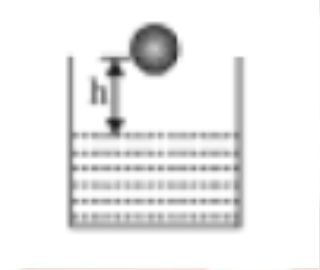
A ball of radius r and density ρ falls freely under gravity through a distance h before entering water. Velocity of ball does not change even on entering water. If viscosity of water is η, the value of h is given by
2/9 r² (¹⁻ ρ/η) g
2/81 r² (ρ - 1/η) g
2/81 r⁴ (ρ - 1/η)² g
2/9 r⁴ (ρ - 1/η)² g
Correct Answer
Detailed Explanation
The value of can be derived from the balance of forces acting on the ball when it reaches terminal velocity in water, where the gravitational force is equal to the drag force . Given that the density of the ball and the density of water are involved, we find that is proportional to and inversely proportional to the viscosity , leading to the expression , which corresponds to option C.
Options A and B incorrectly relate the radius and viscosity in their formulations, while option D misrepresents the relationship by incorrectly squaring the term involving viscosity, leading to incorrect dimensions and values.
Found an issue with this question?