

AIIMS 2008 Physics Soap Films MCQ Question
A thread is tied slightly loose to a wire frame as in figure and the frame is dropped into a soap solution and taken out. The frame is completely covered with the film. When the portion A is punctured with a pin, the thread
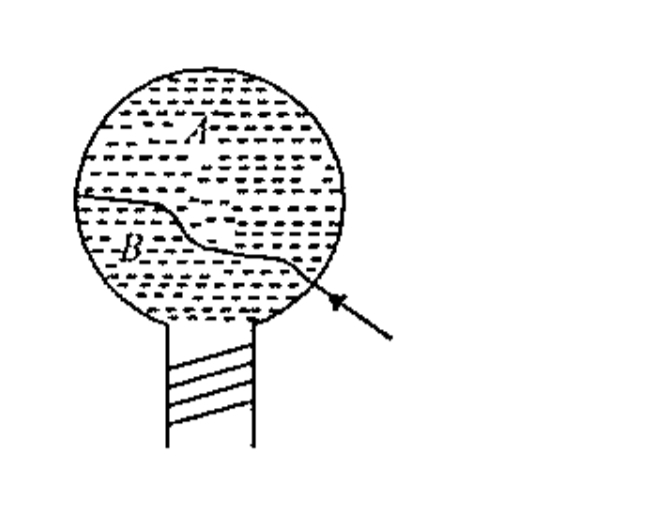
becomes concave towards A
becomes convex towards A
either (a) or (b) depending on the size of A with respect to B
remains in the initial position
Correct Answer
Detailed Explanation
To understand the dynamics of the thread tied to a wire frame covered with a soap film when a portion of the film is punctured, we need to delve into the concepts of surface tension and the behavior of soap films.
Explanation of the Correct Answer (C)
When the soap film is intact, it exerts a tension due to the surface tension of the liquid. Surface tension () is the force per unit length that acts along the surface of a liquid, and it tries to minimize the surface area of the soap film.
When the portion A of the soap film is punctured, the film loses its integrity at that point. The surrounding regions of the film (including the thread) will respond to the change in pressure and surface tension.
-
Concave and Convex Shapes: If the punctured area is small, the remaining film will still maintain a relatively flat structure, and the thread will remain nearly horizontal. If the punctured area is large, the film can no longer maintain its tension uniformly, leading to a more pronounced curvature.
-
Thread Behavior:
- If the area A is much smaller than the surrounding area B, the force exerted by the surface tension can be considered to be concentrated, causing the thread to bow inward (concave towards A).
- Conversely, if A is larger, the surface tension in the remaining film will cause the thread to bow outward (convex towards A) due to the increased pressure difference across the film.
Clarification of Other Options:
-
Option A (becomes concave towards A): This would only be true if the punctured area A is significantly smaller than the area B. This option does not account for variations in the size of the punctured area, hence it is not universally correct.
-
Option B (becomes convex towards A): Similarly, this would only hold if the punctured area A is larger than area B. Like option A, it fails to consider the variability in size.
-
Option D (remains in the initial position): This option contradicts the principle of surface tension. Once the soap film is punctured, the dynamics of the film change, and the thread will adjust due to the new pressure distribution.
Relevant Concepts and Formulas
-
Surface Tension: The force due to surface tension can be represented as:
where is the force, is the surface tension, and is the length of the perimeter of the film exposed to the air.
-
Pressure Difference: The pressure inside a soap bubble is higher than outside due to surface tension. The pressure difference () across a curved surface is given by:
where and are the principal radii of curvature of the surface.
Conclusion
In conclusion, the behavior of the thread tied to the wire frame when the soap film is punctured depends on the relative sizes of areas A and B. Because of this variability, option C is the most accurate choice as it encompasses both potential outcomes (concave or convex) based on the size relationship. Understanding the principles of surface tension and pressure distribution is crucial in analyzing such problems in physics.
Found an issue with this question?