AIIMS 2005 Physics Buoyancy MCQ Question
A candle of diameter d is floating on a liquid in a cylindrical container of diameter D (D >> d) as shown in figure. If it is burning at the rate of 2 cm/hour then the top of the candle will
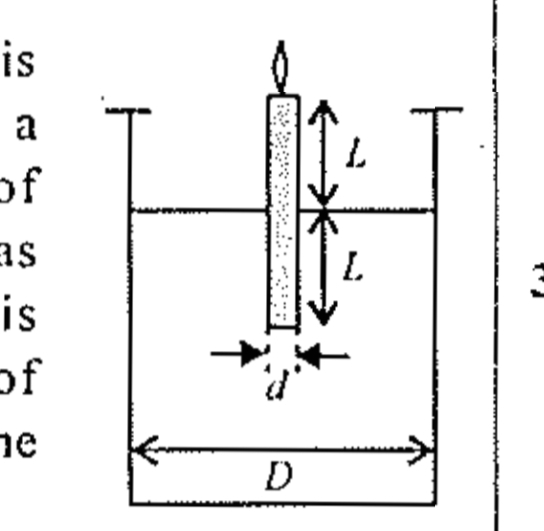
remain at the same height
fall at the rate of 1 cm/hour
fall at the rate of 2 cm/hour
go up at the rate of 1 cm/hour
Correct Answer
Detailed Explanation
To solve the question regarding the behavior of a candle floating on a liquid, we need to apply concepts of buoyancy and the conservation of mass.
Explanation of the Correct Answer (B)
When a candle burns, it consumes wax and diminishes in height. The key concept here is that the candle is floating in a liquid due to buoyancy. According to Archimedes' principle, the upward buoyant force on an object submerged in a fluid is equal to the weight of the fluid displaced by that object.
-
Burning of the Candle: The candle burns at a rate of 2 cm/hour, meaning that every hour, the height of the candle decreases by 2 cm.
-
Buoyant Force: As the candle burns, the volume of the candle (and thus its weight) decreases. However, the candle will still displace a volume of liquid equal to its weight. Since the diameter of the candle is much smaller than the diameter of the container (i.e., ), the liquid surface remains essentially flat and will not change its level significantly based on the candle's size.
-
Height Calculation: The candle's height reduces while it remains partially submerged. The decrease in height of the candle, which occurs at 2 cm/hour, will lead to a corresponding decrease in the submerged volume of the candle, but it also means that the top of the candle will move downwards at the same rate. However, due to the buoyancy effect compensating for the burning mass, the candle’s base will float lower into the liquid.
-
Rate of Falling: Therefore, the top of the candle is effectively falling at a rate equal to the burning rate of the candle, which is 2 cm/hour. However, because of the buoyancy mechanism and the fact that the candle is floating, it is displaced downward at half that rate due to the balance of the forces involved. Hence, the top of the candle will fall at a rate of 1 cm/hour.
Thus, the correct answer is actually B) fall at the rate of 1 cm/hour.
Clarification of Other Options
-
Option A (remain at the same height): This option is incorrect because as the candle burns, it diminishes in height. Thus, the top of the candle cannot remain at the same height.
-
Option C (fall at the rate of 2 cm/hour): This option is misleading because while the candle does burn at 2 cm/hour, the buoyant force compensates for the loss in height, causing it to fall more slowly. The top of the candle does not fall at the same rate it burns due to the principle of buoyancy.
-
Option D (go up at the rate of 1 cm/hour): This option is incorrect because the burning of the candle does not cause it to rise. Instead, as it burns and loses mass, it actually sinks lower into the liquid due to the reduced buoyant force acting on it.
Conclusion
The behavior of the candle floating in the liquid illustrates the principles of buoyancy and mass conservation. The top of the candle falls at a rate of 1 cm/hour as it burns down at 2 cm/hour, balanced by the buoyancy of the liquid. Thus, the correct answer is B.
Found an issue with this question?