AIIMS 2003 Physics Gauss's Law MCQ Question
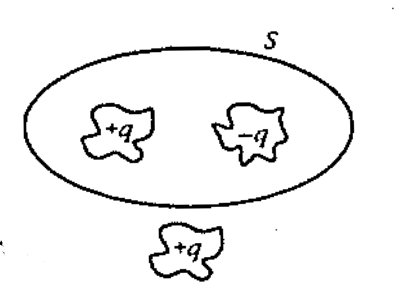
Figure shown is a distribution of charges. The flux of electric field due to these charges through the surface S is
3 𝑞 / 𝜀 0
2q/ε0
q/ε0
zero
Correct Answer
Detailed Explanation
To solve this problem, we need to apply Gauss's Law, which is a fundamental principle in electrostatics. Gauss's Law states that the electric flux through a closed surface is proportional to the charge enclosed by that surface. Mathematically, it is expressed as:
where:
- is the electric flux,
- is the total charge enclosed within the surface,
- is the permittivity of free space.
Explanation of the Correct Answer (D: zero)
The problem states that we need to find the electric flux through a surface due to a distribution of charges. The key to understanding why the correct answer is zero lies in determining whether there are any charges enclosed by surface .
-
Charge Distribution Analysis: If the figure (not visible here) shows that surface does not enclose any net charge (i.e., the charges might be outside the surface or balanced in a way that their net effect cancels out), then according to Gauss's Law, we have:
Thus, the electric flux through surface becomes:
Therefore, the correct answer is D: zero.
Clarification of Incorrect Options
Now let's briefly discuss why the other options (A, B, and C) are incorrect:
-
Option A:
This option implies that there is a net charge of enclosed within the surface . However, if the net charge is zero or not enclosed, this option cannot be correct. -
Option B:
Similar to option A, a net charge of would lead to a non-zero flux. If there are no charges enclosed, this option cannot be correct. -
Option C:
This option suggests that there is a net charge of enclosed within surface . Again, if there is no charge inside, this is not valid.
Conclusion
To summarize, the electric flux through a closed surface is determined by the net charge enclosed by that surface. Since the correct conclusion from the analysis is that there is no net charge enclosed within surface , we find:
Thus, the answer is D: zero. This emphasizes the importance of understanding the charge distribution in electrostatic problems and applying Gauss's Law appropriately.
Found an issue with this question?