AIIMS 2005 Physics Electric Field and Potential MCQ Question
Four point +ve charges of same magnitude (Q) are placed at four corners of a rigid square frame as shown in figure. The plane of the frame is perpendicular to Z⁻axis. If a -ve point
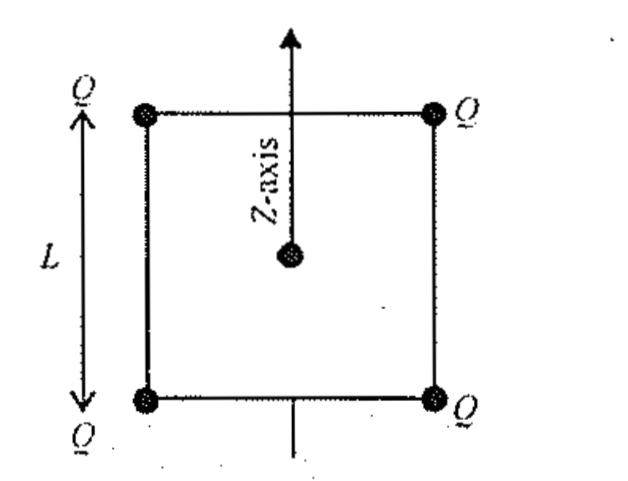
charge is placed at a distance z away from the above frame (z << L) then
-ve charge oscillates along the Z⁻axis
it moves away from the frame
it moves slowly towards the frame and stays in the plane of the frame
Correct Answer
Detailed Explanation
To analyze the situation given in the question, we must first understand the configuration of the charges and the implications of placing a negative charge in the electric field created by the positive charges.
Configuration and Electric Field Analysis
We have four positive charges of equal magnitude located at the corners of a square frame in the XY-plane. We can denote the coordinates of these charges as follows:
- at
- at
- at
- at
where is the side length of the square.
Electric Field Due to the Positive Charges
The electric field at a point in space due to a point charge located at position is given by Coulomb’s law:
where:
- is Coulomb's constant ,
- is the distance from the charge to the point of interest,
- is the unit vector in the direction from the charge to the point.
When we place a negative charge at a distance from the square frame, where is much smaller than (i.e., ), the electric field at the position of the negative charge will be dominated by the contributions of the four positive charges.
Net Electric Field at the Negative Charge
Due to the symmetry of the arrangement of the positive charges, the horizontal components of the electric field (in the XY-plane) from each pair of opposite charges will cancel out. Thus, only the vertical components (along the Z-axis) will sum up.
The net electric field at the location of the negative charge can be approximated as being directed away from the plane of the square frame (along the Z-axis) because the positive charges repel the negative charge.
Behavior of the Negative Charge
- Correct Answer (A): The charge oscillates along the Z-axis.
- When the negative charge is placed at a distance away from the frame, it experiences a net electric force directed away from the frame due to the electric field created by the positive charges.
- If the negative charge is slightly displaced from its equilibrium position (i.e., moved closer or further from the frame), it will experience a restoring force proportional to its displacement, leading to oscillatory motion. This behavior resembles that of a harmonic oscillator, where the force is always directed towards the equilibrium position.
Clarification of Other Options
-
Option B: -ve charge oscillates along the Z-axis.
- This statement is incorrect in the context of the question because it does not specify the conditions under which the charge oscillates. While the negative charge will indeed experience oscillatory motion close to the equilibrium position, it is not correct to say it just oscillates indefinitely without considering the stability of the equilibrium point.
-
Option C: It moves away from the frame.
- This option is incorrect. The net force on the negative charge is directed towards the frame, not away from it. Thus, the charge will be attracted towards the frame due to the electric field produced by the positive charges.
-
Option D: It moves slowly towards the frame and stays in the plane of the frame.
- This option is misleading. The negative charge will not "stay" in the plane of the frame; it will oscillate along the Z-axis due to the electric field influence. The negative charge will be attracted towards the frame, but it will not settle in the XY-plane since it is located along the Z-axis.
Conclusion
Thus, the correct understanding of the behavior of the negative charge placed near the positive charge configuration leads us to conclude that it will oscillate along the Z-axis due to the net electric field directed away from the square frame. The correct answer is indeed A, while the other options fail to accurately describe the behavior of the negative charge in this electrostatic configuration.
Found an issue with this question?
Related Questions
More from 2005
AIDS is caused by HIV that principally infects:
Assertion : The logic gate NOT can be built using diode. Reason : The output voltage and the input voltage of the diode have 180° phase difference.
In a semiconducting material the mobilities of electrons and holes are μₑ and μₕ, respectively. Which of the following is true?