AIIMS 2003 Physics Coulomb's Law MCQ Question
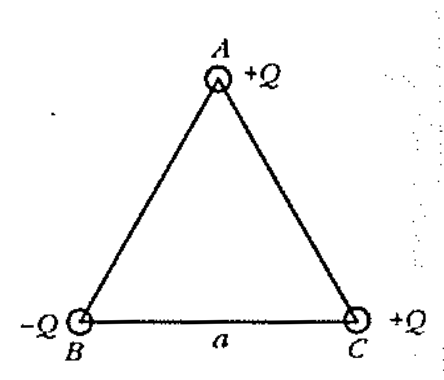
Three charges are placed at the vertices of an equilateral triangle of side a as shown in the given figure. The force experienced by the charge placed at the vertex A in a direction normal to BC is
Q²/4πε₀a²
-Q²(4πε₀a²)
zero
Q²/2πε₀a²
Correct Answer
Detailed Explanation
To solve the problem, we need to analyze the forces acting on the charge at vertex A of the equilateral triangle formed by the three charges. Let's denote the charges at the vertices A, B, and C as , , and , respectively. For simplicity, we can assume that all three charges are equal and have a value of .
Step 1: Identify the Forces Acting on Charge at A
The forces acting on the charge at vertex A due to the other two charges (at vertices B and C) can be calculated using Coulomb's law:
where , and are the magnitudes of the charges, and is the distance between them.
Step 2: Calculate the Forces from B and C
-
Force from Charge B on Charge A:
- The distance .
- The force is given by:
- This force acts along the line connecting A and B.
-
Force from Charge C on Charge A:
- The distance .
- The force is similarly:
- This force acts along the line connecting A and C.
Step 3: Analyze Directions of Forces
For an equilateral triangle:
- The angle between the line connecting A to B and the line connecting A to C is .
- The forces and will have components in the direction normal to line BC (let's denote this direction as the y-axis) and along line BC (the x-axis).
Step 4: Resolve the Forces into Components
-
Components of :
- The x-component (along BC):
- The y-component (normal to BC):
-
Components of (similar calculations):
- The x-component:
- The y-component:
Step 5: Sum the Forces
For the x-components:
For the y-components:
Step 6: Determine the Resultant Force
The force in the direction normal to BC (the y-direction) is:
However, it is important to note that the x-components cancel each other out due to symmetry (they are equal and opposite), resulting in no net force in the x-direction. Therefore, the net force experienced by charge A in
Found an issue with this question?