AIIMS 2003 Physics Magnetic Effects of Current MCQ Question
A rectangular loop carrying a current i₁ is situated near a long straight wire carrying a steady current i₂. The wire is parallel to one of the sides of the loop and is in the plane of the loop as shown in the figure. Then the current loop will
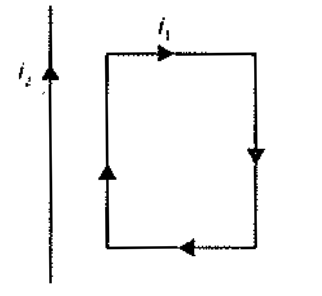
move away from the wire
move towards the wire
remain stationary
rotate about an axis parallel to the wire
Correct Answer
Detailed Explanation
To understand why the rectangular loop carrying a current will move towards the wire carrying a current , we need to analyze the magnetic forces acting on the loop due to the straight wire and the interaction between the two currents.
Explanation of the Correct Answer (B: Move Towards the Wire)
-
Magnetic Field Due to a Straight Wire: A long straight wire carrying a current produces a magnetic field around it described by the Biot-Savart Law. The magnetic field at a distance from a long straight wire is given by the formula:
where is the permeability of free space.
-
Direction of Magnetic Field: The direction of the magnetic field produced by the wire can be determined using the right-hand rule. If you point your thumb in the direction of the current , your fingers curl around the wire indicating the direction of . For a wire carrying current upwards, the magnetic field circles around the wire in a counterclockwise direction.
-
Force on the Loop: The rectangular loop carrying current experiences a magnetic force due to the magnetic field created by the wire. The force on a segment of wire in a magnetic field is given by:
where is the length vector of the wire segment within the magnetic field.
-
Effect on the Loop:
- The side of the loop that is closest to the wire will experience a magnetic force directed towards the wire, since the current direction and the magnetic field direction will create an attractive force.
- Conversely, the side of the loop that is farther away will experience a weaker field and thus a lower force.
- The net effect is a resultant force that pulls the loop towards the wire.
Why Other Options are Incorrect
-
Option A (Move Away from the Wire): This option is incorrect because the magnetic interaction between the two currents leads to an attractive force, as explained. There is no scenario in which the loop would experience a force that causes it to move away from the wire.
-
Option C (Remain Stationary): The loop cannot remain stationary because the magnetic forces acting on it due to the wire will cause it to move. If the currents are steady, the magnetic field is constant, and thus the force will continually act on the loop.
-
Option D (Rotate about an Axis Parallel to the Wire): The loop does not rotate. The forces acting on the loop are not equal and opposite on both sides; instead, they create a net force that causes linear motion towards the wire rather than rotational motion.
Summary
In summary, the rectangular loop carrying a current experiences an attractive force due to the magnetic field generated by the straight wire carrying a current . This attractive force causes the loop to move towards the wire, making option B the correct answer.
The relevant concepts here are the magnetic fields produced by currents and the forces acting on current-carrying conductors in a magnetic field, which are foundational in the study of electromagnetism and its applications.
Found an issue with this question?