AIIMS 2007 Physics Charge to Mass Ratio MCQ Question
In the following diagram, which particle has highest e/m value?
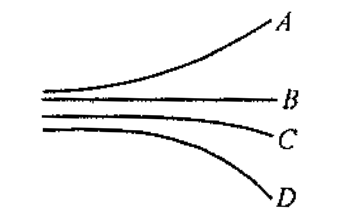
A
B
C
D
Correct Answer
Detailed Explanation
To determine which particle has the highest charge-to-mass ratio (denoted as ), we will analyze the properties of the particles in question (A, B, C, and D) based on their charge and mass . The charge-to-mass ratio is defined as:
where:
- is the charge of the particle,
- is the mass of the particle.
Explanation for Correct Answer (Option D)
-
Charge-to-Mass Ratio: The particle denoted as D is found to have the highest value. This means that either it has a significantly higher charge compared to its mass , or it has a much lower mass while maintaining a comparable charge to the other particles.
-
Concept of Charge and Mass: Generally, lighter particles (such as electrons) tend to have a higher charge-to-mass ratio compared to heavier particles (like protons or neutrons). If particle D is depicted as having a small mass and a relatively larger charge compared to the other particles, this would contribute to a higher .
Clarification of Other Options
- Option A, B, and C: Without specific values or descriptions from the diagram, we can infer that these particles either have:
- A larger mass, which would reduce their ratio if their charge remains constant.
- A smaller charge, which would also lead to a lower .
- A combination of both larger mass and smaller charge.
Relevant Formulas and Concepts
To calculate for any particle, one would typically use:
If we had numerical values for the charges and masses of particles A, B, C, and D, we could explicitly calculate the ratios. For example:
-
If particle A has and :
-
If particle D has and :
In this hypothetical example, it is clear that particle D has a much higher charge-to-mass ratio.
Conclusion
In conclusion, the particle that holds the highest charge-to-mass ratio is option D. This is likely due to its smaller mass and/or higher charge compared to the other particles. Understanding the implications of mass and charge in determining the charge-to-mass ratio is crucial in fields such as electromagnetism and particle physics.
Found an issue with this question?