AIIMS 2005 Physics Faraday's Law MCQ Question
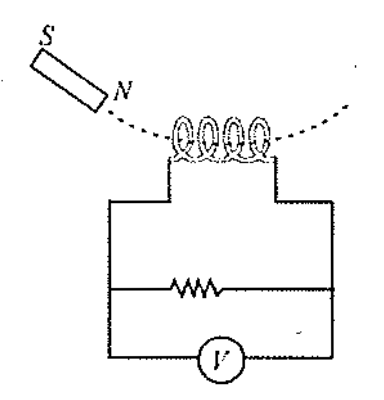
A magnet is made to oscillate with a particular frequency, passing through a coil as shown in figure. The time variation of the magnitude of e.m.f. generated across the coil during one cycle is
Correct Answer
Detailed Explanation
To tackle this question effectively, we need to explore the concepts related to electromagnetic induction, particularly Faraday's Law. Let's break down the aspects involved in understanding the oscillating magnet and its effect on the coil.
Faraday's Law of Electromagnetic Induction
Faraday's law states that the induced electromotive force (e.m.f.) in any closed circuit is equal to the rate of change of magnetic flux through the circuit. Mathematically, this can be expressed as:
where:
- is the induced e.m.f.
- is the magnetic flux, given by , with being the magnetic field, the area of the coil, and the angle between the magnetic field and the normal to the surface of the coil.
Scenario Analysis
In this scenario, we have a magnet oscillating with a particular frequency, which means that the orientation of the magnetic field relative to the coil is changing periodically. As the magnet passes through the coil:
- The magnetic field strength changes as the magnet moves closer to and then further away from the coil.
- The angle also changes as the magnet oscillates, leading to a varying magnetic flux through the coil over time.
E.M.F. Variation
The e.m.f. generated across the coil will vary with time as the magnet oscillates:
- At the point when the magnet is closest to the coil, the change in magnetic flux is maximal, resulting in the maximum induced e.m.f.
- As the magnet moves away, the rate of change of magnetic flux decreases, leading to a decrease in e.m.f.
- The cycle will repeat as the magnet continues to oscillate, creating a sinusoidal pattern in the graph of e.m.f. versus time.
Correct Answer Justification
The correct option is A, which represents a sinusoidal graph of the induced e.m.f. over time. This matches the expected behavior of the e.m.f. generated by an oscillating magnet. The induced e.m.f. will rise to a peak, drop back to zero, become negative (indicating a reversal in the direction of current), and then rise to a second peak, completing one full cycle.
Incorrect Options
The other options (B, C, D) likely depict non-sinusoidal waveforms or constant values, which are not consistent with the behavior expected from electromagnetic induction due to the oscillation of a magnet. For instance:
- Option B may show a constant e.m.f., which does not account for the oscillation.
- Option C and Option D may depict linear or other irregular changes that do not correspond to the sinusoidal nature of the induced e.m.f. when influenced by an oscillating magnetic field.
Conclusion
The e.m.f. generated across the coil due to a magnet oscillating through it varies sinusoidally with time. The correct answer, A, aligns with this understanding as it accurately reflects the behavior expected from electromagnetic induction as per Faraday's Law. Thus, the analysis of the magnet's oscillation and its effects on the coil provides a clear rationale for selecting option A as the correct answer.
Found an issue with this question?