AIIMS 2006 Physics Electric Field Lines MCQ Question
The spatial distribution of the electric field due to two charges (A, B) is shown in figure. Which one of the following statements is correct?
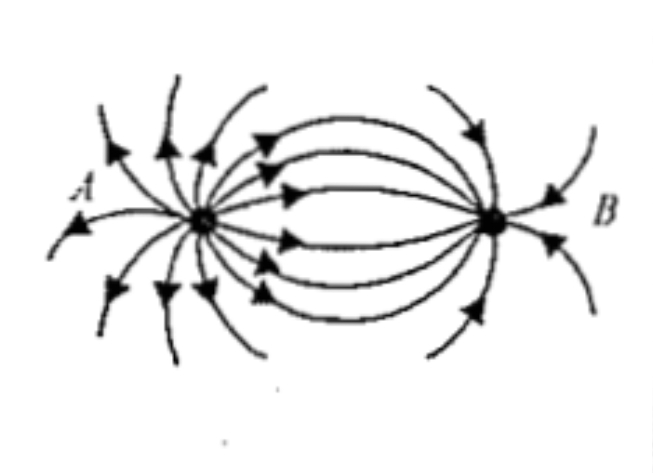
A is +ve and B is -ve and |A| > |B|
A is -ve and B is +ve; |A| = |B|
Both are +ve but A > B
Both are -ve but A > B
Correct Answer
Detailed Explanation
To analyze the question regarding the spatial distribution of the electric field due to two charges (A and B), we need to understand how electric field lines behave around different types of electric charges.
Key Concepts
-
Electric Field Lines: The direction of electric field lines indicates the direction of the force experienced by a positive test charge placed in the field.
- Lines originate from positive charges and terminate at negative charges.
- The density of electric field lines represents the strength of the electric field; closer lines indicate a stronger field.
-
Charge Magnitude and Sign:
- Positive charges generate electric fields that point away from them.
- Negative charges generate electric fields that point towards them.
Analyzing the Correct Answer
Correct Answer: A) A is +ve and B is -ve and |A| > |B|
- Justification:
- If charge A is positive and charge B is negative, the electric field lines will originate from A and terminate at B, which is consistent with the behavior of electric fields.
- The fact that the density of the field lines is greater near charge A suggests that the magnitude of charge A is greater than that of charge B (i.e., ).
- Thus, the electric field lines are denser around charge A, indicating a stronger electric field due to charge A compared to charge B.
Clarifying Why Other Options Are Incorrect
Option B: A is -ve and B is +ve; |A| = |B|
- This is incorrect because if A were negative and B were positive, the electric field lines would point towards A and away from B, which contradicts the condition where field lines should originate from a positive charge and terminate at a negative charge. Additionally, the statement that would imply equal field strength, which is not supported by the density of lines shown in the figure.
Option C: Both are +ve but A > B
- This option is also incorrect as both charges being positive would mean that the electric field lines would not terminate anywhere, leading to a scenario where the field lines would repel each other. Hence, there would be no convergence of field lines towards a negative charge.
Option D: Both are -ve but A > B
- This is incorrect as well. If both charges were negative, the field lines would point towards each charge, leading to a scenario where they would repel each other. Similar to option C, there would be no convergence of field lines towards a positive charge, which contradicts the behavior expected in the scenario.
Summary
In conclusion, the correct interpretation of the electric field lines indicates that charge A is positive, while charge B is negative, with the magnitude of charge A being greater than that of charge B. This understanding aligns with the behavior of electric fields and their representation through field lines, confirming that option A is the only valid statement in this context.
The underlying formulas related to electric fields can be summarized as follows:
- The electric field due to a point charge is given by:
where is Coulomb's constant and is the distance from the charge. The direction of is outward for positive charges and inward for negative charges.
Found an issue with this question?