AIIMS 2005 Physics Voltage in AC Circuits MCQ Question
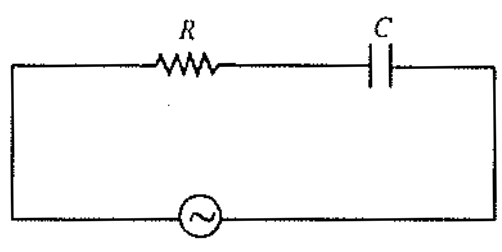
A 50 Hz a.c. source of 20 volts is connected across R and C as shown in figure. The voltage across R is 12 volt. The voltage across C is
8 V
16 V
10 V
not possible to determine unless values of R and C are given.
Correct Answer
Detailed Explanation
To solve the problem, we need to determine the voltage across the capacitor in an AC circuit where a 20 V (rms) AC source is connected across a resistor and a capacitor . The voltage across the resistor is given as 12 V.
Step 1: Understanding the Circuit
In an AC circuit with a resistor and capacitor in series, the total voltage is the vector sum of the voltages across the resistor and the capacitor .
Using the concept of phasors, we know that:
- The voltage across the resistor is in phase with the current.
- The voltage across the capacitor lags the current by .
Step 2: Applying the Pythagorean Theorem
Since the voltages are out of phase, we can use the Pythagorean theorem to relate the total voltage , the voltage across the resistor , and the voltage across the capacitor :
Step 3: Plugging in Values
We know:
- The total voltage
- The voltage across the resistor
Substituting these values into the equation gives:
Calculating and :
Step 4: Solving for
Now, isolate :
Taking the square root to find :
Thus, the voltage across the capacitor is .
Conclusion
The correct answer is B) 16 V.
Clarifying Other Options
- A) 8 V: This value does not satisfy the Pythagorean relationship established between the voltages.
- C) 10 V: This value also fails to fulfill the condition since substituting does not satisfy the equation .
- D) Not possible to determine unless values of R and C are given: This option is incorrect because we can determine the voltage across the capacitor with the given voltage across the resistor and the total voltage.
Thus, the only valid conclusion based on the provided information is that the voltage across the capacitor is indeed .
Found an issue with this question?